
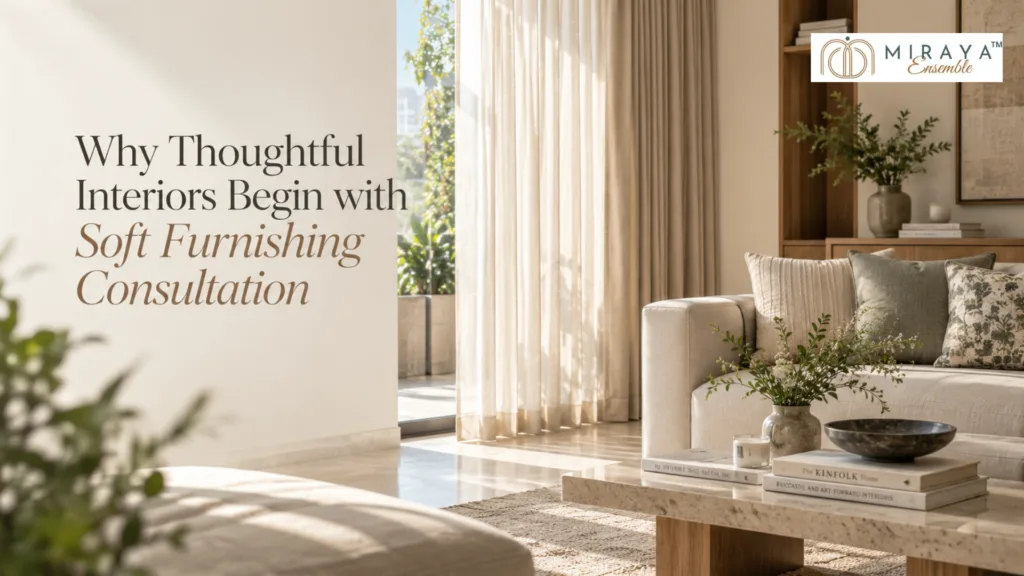
The most resolved interiors rarely come from choosing the most beautiful fabric in isolation. They come from understanding how every element belongs together: how a curtain meets the ceiling, how a blind sits within a recess, how upholstery relates to the architecture, how natural light changes colour through the day, and how each textile layer contributes to the composition of the room.
That is the value of a professional soft furnishing consultation.
Soft furnishings may be tactile and decorative, but their success depends on much more than fabric selection. Curtains, blinds, upholstery and other textile layers need to be considered in relation to proportion, light, movement, furniture, hardware and the architecture itself. When these decisions are made as one composition rather than as separate purchases, a room begins to feel instinctive rather than assembled.
At Miraya Ensemble, consultation is approached in precisely this way: as the point where aesthetics, functionality and thoughtful detailing come together. The objective is to understand what the room needs and resolve those decisions early. This reflects Miraya Ensemble’s consultation-led, made-to-measure approach, where every decision is considered as part of the complete interior composition.
Thoughtful Interiors Begin with Composition, Not Product
Soft furnishings are often discussed in terms of products: a curtain for one window, a blind for another, a new fabric for a sofa. Yet a thoughtful interior is not experienced as a collection of individual products. It is experienced as a whole.
This is why a soft furnishing consultant begins with composition.
Consider a living room with full-height glazing, an upholstered sofa, occasional chairs and a strong architectural rhythm. The curtain is not simply a fabric hanging beside the window. Its height changes the perceived proportion of the room. Its fullness determines whether the treatment appears generous or visually heavy. Its heading and track position influence how cleanly it meets the ceiling. Its colour and texture need to converse with upholstery, flooring, walls and natural light.
A blind in an adjoining room may need to perform differently while still belonging to the same visual language. Rather than selecting each treatment independently, the consultant considers how custom curtains and blinds relate through tone, texture, scale and proportion.
The same principle applies to bespoke curtains and upholstery. Upholstery should not merely “match” the curtains. A more sophisticated composition may rely on subtle relationships: a shared undertone, a shift in texture, a repeated material quality or a deliberate contrast in weight. One textile can be quiet because another carries more presence.
This is what composition over product means in practice. The question changes from “Which curtain should we buy?” to “What does this room need to feel complete?”
That shift creates interiors that feel more considered, because every choice is made in response to the space rather than in isolation from it.
The Technical Decisions Behind Effortless Soft Furnishings
Beautiful soft furnishings often appear effortless when complete. Achieving that simplicity, however, requires technical decisions that begin well before fabrication.
Miraya Ensemble’s role extends beyond an interior fabric consultation into the practical architecture of how each treatment will work: tracks, hardware, automation, recesses, electrical provisions, measurements and installation all affect the final result.
A curtain track, for example, is not merely a fitting hidden above the fabric. Its location influences curtain height, stack-back and how much glass remains exposed when the curtains are open. The strength and configuration of the hardware must also be suitable for the weight and construction of the finished treatment.
Recesses matter just as much. A blind planned for a shallow recess may behave very differently from one incorporated into the architectural detailing from the outset. Handles, frames, skirting, ceiling drops, air-conditioning elements and furniture positions can all affect clearance.
Automation introduces another layer of coordination. Motorised curtains and blinds can involve decisions around the track system, controls, motor location and electrical provision. Motorised systems may be wired or wire-free, depending on the treatment, window dimensions and automation requirements.
Planning automation early allows tracks, recesses and electrical requirements to be integrated cleanly, so the technology works intuitively without interrupting the design.
Accurate measurements are equally fundamental. Small discrepancies can affect the finished drop of a curtain, the alignment of a blind or the relationship between a window treatment and surrounding joinery. Professional measurement therefore considers not only dimensions but the intended finished composition.
Installation is the final translation of all these earlier decisions. A beautifully specified textile cannot compensate for a poorly positioned track or rushed fitting. Conversely, when design, fabrication, hardware and installation have been coordinated from the beginning, technical expertise becomes almost invisible: the curtain clears the floor correctly, the blind operates smoothly, the folds sit with intention and the window feels integrated into the architecture.
That seamless result is not accidental. It is designed.
Luxury Is Discernment, Restraint and Thoughtful Choice
Luxury in an interior does not have to announce itself through abundance.
At its most enduring, luxury is discernment: understanding what deserves emphasis, what should recede, where craftsmanship matters and when restraint creates greater impact than addition.
Intention over excess. Timeless over trend. Composition over product.
This philosophy is especially relevant to luxury soft furnishings, where it can be tempting to equate more layers, more detailing or more expensive materials with a more luxurious result.
Often, the opposite is true.
A beautifully proportioned curtain in the right textile may create more presence than an elaborate treatment with unnecessary trims. A carefully chosen upholstery fabric can bring depth without competing with artwork or architecture. A quiet blind can disappear when required and allow a view, material or structural detail to remain dominant.
Restraint is not about making a room sparse. It is about editing.
A considered consultation asks what each textile is contributing. Does another pattern improve the composition, or interrupt it? Does a heavier material give the room the visual weight it needs, or make it feel unnecessarily formal? Should the window treatment become a feature, or support the architecture quietly?
Material performance is part of that discernment as well. Fibre content, construction, light exposure and expected use all influence whether a fabric is appropriate for its application. Colourfastness, durability, construction strength and dimensional stability matter just as much as appearance when selecting a textile for long-term use.
For a home, that principle translates into practical questions. A fabric used on an occasional chair faces different demands from one covering a family sofa. A curtain exposed to intense sunlight needs to be considered differently from drapery in a protected room. A material that photographs beautifully may not necessarily be the material that will age most gracefully in that particular setting.
True luxury lies in knowing the difference.
Protecting the Client’s Investment Starts with Getting the Details Right
The value of professional consultation is not simply measured at the moment a fabric is selected. It becomes clearer over the life of the interior.
A curtain can be beautifully made yet require correction if the track position was not resolved properly. A blind can conflict with a window handle if clearance was not considered. Upholstery specified primarily for colour may prove unsuitable for the amount of daily use it receives. An automated treatment planned too late may require an inelegant compromise with electrical points or ceiling details.
Each of these situations can lead to rework, additional fabrication, repeated installation, delays or premature replacement.
The stronger narrative, therefore, is not about finding the least expensive specification. It is about protecting the client’s investment by making informed decisions before materials are ordered and work begins.
That distinction matters.
A soft furnishing consultation helps determine where craftsmanship and premium materials will genuinely improve the room, where a simpler solution is more appropriate and which technical decisions need to be coordinated with the wider project.
Sometimes the most considered choice is an exceptional textile in a focal area. Elsewhere, the better choice may be a quieter performance fabric capable of handling everyday use. A bespoke treatment may transform an unusually proportioned window, while another part of the home may benefit from a restrained, technically straightforward solution.
The purpose is not uniform expenditure. It is intelligent allocation.
When the specification is appropriate to the architecture, lifestyle and expected performance, the client’s investment is better protected from incorrect specifications, avoidable rework and replacement that arrives earlier than it should.
That is a more meaningful definition of value.
Miraya Ensemble’s End-to-End Process Keeps the Design Intention Intact
One of the risks in soft furnishings is fragmentation.
A designer establishes the concept. Someone else supplies a fabric. Another party measures the windows. A fabricator interprets the specification. A hardware vendor deals with the track. The installer arrives at the end. When these stages operate independently, small discrepancies can accumulate between the original design intention and the finished room.
Miraya Ensemble’s approach is designed to maintain continuity across that journey.
The process begins with the space itself: understanding its architecture, light, lifestyle requirements, existing finishes and overall design direction. From there, fabrics, treatments, textures and proportions can be developed as a composition rather than as isolated product selections.
Technical requirements are considered alongside aesthetics. Measurements inform fabrication. Tracks and hardware are aligned with the treatment. Automation and electrical requirements can be raised early where relevant. Installation is considered part of the design outcome rather than an unrelated final task.
Miraya Ensemble’s end-to-end soft furnishing services formally include consultation and mood boards, fabric and trim selection, space planning, made-to-measure products, final installation and styling, alongside turnkey soft furnishing solutions and collaboration with architects and designers.
This continuity is particularly important when several rooms are being furnished together.
A home should not feel as though every window was designed in isolation. There may be different functional requirements from room to room — blackout in a bedroom, filtered daylight in a living space, easy maintenance in a high-use area — but the overall composition can still share a coherent visual language.
That might come through repeated tonal relationships rather than identical fabrics. It may appear through consistent track positions, related curtain headings, carefully controlled material weights or a recurring balance between softness and structure.
The objective is coherence without repetition.
It is also where Miraya Ensemble’s combination of aesthetics, functionality and technical expertise becomes most valuable. The consultation establishes the intention; detailed specification protects it; fabrication gives it form; and installation ensures the finished result reflects what was envisioned at the beginning.
Frequently Asked Questions
Ideally, a consultant should be involved before key architectural and electrical decisions around the windows are finalised. Early involvement allows curtain tracks, blind recesses, automation, electrical provisions, furniture positions and window-treatment proportions to be considered together. For renovations or already completed homes, consultation can still identify the most appropriate solutions within existing conditions.
The scope can extend well beyond choosing fabrics. A considered consultation may address the visual composition, curtain and blind types, upholstery, textile suitability, measurements, track and hardware requirements, lining, light control, automation, recess conditions, electrical coordination, fabrication and installation. Miraya Ensemble’s own service model combines design consultation with made-to-measure and installation-led support.
No. The value lies in making appropriate decisions, not in adding more products. A single room can benefit from the same thinking: understanding proportion, choosing the correct material, resolving the window treatment technically and ensuring it works with what is already present.
Yes. A cohesive composition does not require replacing everything. Existing sofas, chairs, flooring, artwork and finishes can provide the starting point. New textiles can then be introduced to create continuity, refine the balance of colour and texture, and strengthen the relationship between furnishings and architecture.
Yes, particularly when the design requires concealed tracks, integrated recesses or wired motors. Product requirements vary: motorised curtain systems can differ in track capacity, controls and power supply, while battery-operated alternatives are also available. Resolving the preferred system early allows the furnishing consultant, interior designer, architect and electrical team to coordinate the detail before finishes are complete.
Final Thoughts
Thoughtful interiors are defined by the relationship between their elements, not by their quantity.
Curtains, upholstery, hardware and automation each influence how effortlessly a room looks and functions, even when the technical details themselves disappear from view.
This is where Miraya Ensemble’s approach to professional soft furnishing consultation becomes distinct.
By bringing aesthetics, function and technical detailing into one process, each textile layer can respond naturally to the architecture and to everyday life.
For those beginning a new home, refining an existing interior or coordinating furnishings alongside an architect or designer, the process can begin with a soft furnishing consultation that considers the whole space before individual products are selected. At Miraya Ensemble, consultation is the first step—before fabrics are selected or windows are measured—allowing every recommendation to respond to the client’s space, functional requirements and design vision.
The result is luxury through clarity: considered materials, appropriate performance and details resolved with intention.
“Meaningful luxury is not about adding more. It is about making every choice count—intention over excess, timeless over trend and composition over product. Inspired by you. Created in luxury.”